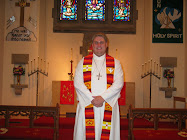
An informal and ongoing journey into the pastoral office and pastoral ministry, where art imitates life and vice versa. Art and aesthetics are gifts from God. This blog will not be limited to those topics, but will affirm and celebrate that truth.
Let me just say this right off the bat: I never read the Thor comic. I knew who The Mighty Thor was, but I can honestly say I never read an issue. That didn't stop me from knowing a few scant details about the character. So, I saw the film. I was not disappointed; neither with the movie, nor with its yielding of theological subject material or insights.
If there is a problem I have with superhero films it is that the bulk of them are origin stories. But, it in this case, this was helpful. I'm not sure how faithful the film is to the comic storyline. But, I felt like I got a decent sense of the basics.
The eponymous main character is the son of the Norse deity Odin. It is at this point that I should probably inform you, dear reader, that my knowledge of Norse mythology is as limited as my knowledge of the Thor comic. Thor is also the brother (by adoption) of Loki. Apparently, Loki is some sort of trickster or mischievous deity.
There is much to discuss theologically. The deities have some human attributes (human form, the ability to lose limbs, the ability to die) to accompany their fantastic powers. This could spur a discussion of ancient religions, as well as present-day polytheistic religions. It could also start a good discussions of what exactly, the attributes of God are.
There is also the issue of Thor being "worthy" of the title/office (or, vocation) of King of Asgard. This can lead to several possibilities for discussion or illustrating. The first is, obviously, the sonship of Jesus. Another is how we obtain worthiness before God (what our sinful nature tells us vs. what Scripture teaches).
Another issue that could be addressed is Thor's hammer. This is of particularly of interest to Lutherans, especially if you've read the novel "The Hammer of God". This could be a way to introduce the book. Thor's hammer is one of the most powerful weapons in the universe. The Word of God happens to be the most powerful thing in the universe in real life. The connection is obvious.
This film is a good way to kill a couple of hours. It's not the best film ever, but it's not too bad. The hardcore fans will always find something to criticize, but I think the film could serve as a decent springboard to some good discussion. But, realize, there are better superhero film which would serve that purpose.
I had been anticipating this film ever since I saw the trailer. The trailer led me to believe that the film would address some of the issues that I struggle with, both personally and professionally. I was not disappointed.
The film (based on a story by Philip K. Dick) tells the story of a hot-shot politician, who meets a woman by chance on the night of an electoral defeat. He then sees her again by pure chance. The problem is that he is not "supposed" to see her again. At this point, a group of men in suits and hats steps in to stop the ripples that will occur due to this chance meeting.
The plot centers around the politician and this woman. But more than just a simple love story is the heart of the issue. This pair's couplehood goes against something that is constantly referred to as "the plan".
So often, Christians (both ordained, and non-ordained) are caught repeating their catchphrase, "God has a plan for your life." Many different varieties of Christians can say that phrase, and even mean it. But it means very different things to different breeds of Christians.
Some of the issues addressed by the film are good questions that many people have: Does God have a plan? What does that mean? How much of the plan do we have control over? How much can we influence the plan? Is the plan adjustable? Does it matter if we don't understand the plan? Should we worry about trying to understand the plan or merely worry about following it? All of these are good, honest questions that regular people in the pews (and sometimes the pulpits) wrestle with.
How would you preach the idea of "God's Plan"? How would you answer the questions listed above?
GOSPEL HANDLES
The film shows that there is grace when we slip up, and redemption (or recovery) is possible.
"So let's shut up and bite this Lilliputian-sized tax bullet. Help keep some great old paintings and some deranged new ones in plain view of the average citizen, and at the same time, help defend individual expression against the first wave of the brain gendarmes."
Lately, I've gotten back into the practice of listening to books on tape or CD in my car instead of music or the radio. This certainly helps out with my goal of reading 75 books by the end of the year. It also gives me a quite a variety of reading/listening material.
The book I most recently finished was A Match Made in Heaven by Robert L. Mitchell. It tells the story of a Harvard professor named Elliott Goodman. The good professor has a heart attack, and while the hospital staff is trying to save his life, a dialogue with God. God asks why he should spare Elliott. God gives him a chance to save his life by playing golf. God sends down 18 icons of human history to play against Elliott, 1 per hole. he plays for his life against people like Leonardo DaVinci, John Lennon, Babe Ruth, Edgar Allan Poe, Moses, Gandhi, Socrates, and others.
This is not a Christian book, and will not match Christian theology in any manner. However, that's not really the aim of this post. While I enjoyed the book's depictions of the historical figures, and the parallels it made between golf and life, it did get me thinking about another thing.
Suppose I were in the same situation. Who would I want to play golf against, given the chance? Here's my list. The numbers correspond only to people. They are not indicative of hole numbering. It should also be noted that no one on the list is still living. I will amend the list as the situation demands.
1. St. Paul 2. Johnny Cash 3. Humphrey Bogart 4. Albert Einstein 5. Richard Wright 6. Cole Porter 7. Benjamin Franklin 8. Langston Hughes 9. Martin Luther 10. Katherine Hepburn 11. Kate Chopin 12. Curly Howard 13. Henri Nouwen 14. Rod Serling 15. Martin Luther King, Jr. 16. Fred Rogers 17. Basil Rathbone 18. Charles M. Schulz
I have never seen the cartoon on which this film is based. I saw this film because I'm a big fan of its director, M. Night Shyamalan. I've been a fan since The Sixth Sense. I hated The Happening. So, I was eager to see him bounce back. I was not disappointed! I know many professional critics dislike this film. That's fine, they're entitled to their educated opinion.
The plot itself seemed convoluted to me, but this is largely due to my own lack of familiarity with the source material. Fortunately, other people summarize the plot much better than I do. Yahoo! gives the following: "Air, Water, Earth, Fire. Four nations tied by destiny when the Fire Nation launches a brutal war against the others. A century has passed with no hope in sight to change the path of this destruction. Caught between combat and courage, Aang discovers he is the lone Avatar with the power to manipulate all four elements. Aang teams with Katara, a Waterbender, and her brother Sokka to restore balance to their war-torn world."
Fortunately, this blog is more dedicated to spiritual issues than plot. And this film is loaded with spiritual issues. Examples include the power of belief, communing with a 'spirit world", reincarnation, dedication to religious vocations, as well as others which I know I am overlooking.
Many critics, profession and otherwise, and many filmgoers in general have given up on Shyamalan. But, the above paragraph explains why I have not. Regardless of the aesthetic merits of most his work post-Signs, his films speak to me. I thought about why this is. Then it hit me, the films of his which I love (all except The Happening) deal with persons trying to find their purpose. I've struggled with that issue personally.
Regarding theological issues, the films seems to be a conglomeration of various Eastern theologies. The discerning viewer will want to familiar with the basics of such religions as Buddhism and Hinduism, as well as pantheism. That sounds like a LOT of effort, just to see a movie, but it IS worth it.
Spiritual issues the film discusses include purpose, reincarnation, supernatural powers, monasticism, as well as others, such as corruption of power.
GOSPEL HANDLES
Aang (though a reincarnation of the Avatar), is the chosen one who will save the people. He is the only one who can master all the elements. He has special tattoos (markings) which identify him as the Avatar.
Also, there is a scene where the princess of the water tribe sacrifices herself so the people can be saved.
CLERGY HANDLES
Monks and priests abound in this film. They live in temples. They are not Christian monks or priests, though it is unclear what religion they actually are.
Many of our parishioners have children who are quite familiar with the cartoon series. That alone makes it worth seeing. I enjoyed the film, and still believe in M. Night Shyamalan, even if everyone else doesn't.
"Epic poetry and Tragedy, Comedy also and Dithyrambic poetry, and the music of the flute and of the lyre in most of their forms, are all in their general conception modes of imitation. They differ, however, from one another in three respects, -the medium, the objects, the manner or mode of imitation, being in each case distinct."
Recently, 2 popular television series ended. I was a neither a fan or regular watcher of either LOST (ABC) or 24 (FOX). Millions of people are. I was told, however, that the series' finales both offered up a decent dose of sermon illustrations. Maybe that is true.
But it sort of brings up a larger question. Do I need to see everything to be truly culturally attuned? I don't think so.
The drawback, of course, is being accused of not liking something, taking offense, and reacting when you have not seen it. This, unfortunately, is rampant in Christian circles. What I am trying to say, is that you run the risk of operating solely on the principle of "someone told me to be offended, so I am". But then again, you also run the risk of praising something you have no clue about (as in Mark Twain's definition of a classic).
What about you? were you a fan of either of these shows? If so, how did/does it affect your preaching? Do you feel the need to check out every reference you preach on or criticize?
So, I finally saw this film. I say it that way because I had been wanting to see it since it was released a few weeks ago. Before I begin the actual review, I should state two important things:
1. I love superheroes, and the movies made about them. 2. I don't read comic books. I used tot read and collect them. And of the ones I did read, Iron Man was NOT one of them. It wasn't from a lack of interest. I just discovered I was reading too many titles that could not be supported by the budget of an unemployed teenager.
Now, onto my analysis.
Iron Man 2 is exactly what you want in a sequel: familiar characters and stars, enough of a recap of the original work, a sort-of picking up where the story left off, and it should not be as good as the original. The Godfather, Part II is the only known exception to this last criteria.
The film carries on the story of titan of industry, wealthy playboy, and technological genius Tony Stark. Stark, in the Iron man armor, has brought about a type of world peace. This has not escaped the notice of the United States government, who wishes to acquire the technology and use it for themselves. Stark refuses to sell to them. Meanwhile, in Russia, a heavily-tattooed physicist is making plans to get revenge on Tony Stark for perceived injustices committed against his father by Tony Stark's father during the Cold War. He tries to accomplish this by constructing a a rip-off (based on original designs) of Iron Man's (and Tony Stark's) ARC reactor. He then constructs a sort of exoskeleton which brandishes electrically-charged whips in each hand.
The film is essentially, even if unintentionally (I suspect intentional, though) about contrasts. Let me provide a few examples. Malibu, where Tony Stark resides, is always sunny and has perfect weather. (I have never been there, but I am told this is pretty accurate.) Russia is depicted as being gray, always overcast, and almost always snowing. Further, the film contrasts the sleek, sparkling, and sexy Iron Man armor with the crude exoskeleton of Whiplash. Then we are faced with the contrast of motives. The film contrast the (supposedly) pure motives of Tony Stark/Iron Man with not only the motives of revenge displayed by Whiplash, but also the motive of the United States government (is it to wage war or preserve peace?).
GOSPEL HANDLES
There's a fascinating line by Whiplash in the film when he describes his motive for wanting revenge on Tony Stark. He says, "If you could make God bleed, people would cease to believe in him." What do we, as Christians (and pastors) do with that? After all, we believe that, on the cross, God DID bleed. How would you preach this?
Also, the story that unfolds in the film, is partially a Gospel handle itself. It starts with a "very good" design (the Iron Man armor) which is then co-opted by something/someone evil, made to create chaos and bring about death, and finally is redeemed. What other Gospel Handles did you see? I can think of at least two.
CLERGY HANDLES
There are no depictions of clergy in this film.
All in all, I found this movie to be solid for a sequel. There were some parts that dragged, but on the whole it was pretty good. The lulls are salvaged by good performances by Don Cheadle, Scarlett Johansson, and especially, Gwyneth Paltrow and Mickey Rourke. Also noteworthy was the brief part played by Garry Shandling.
"The act of singing together is deeply and indelibly human. When we sing, words are given greater range and power than when we speak. Something is shared in singing that goes beyond the words alone. Among Christians, this something has taken shape over many centuries in a practice that expresses our deepest yearning and dearest joy: the practice of singing our lives."
--Don E. Saliers (in "Singing Our lives" in Practicing Our Faith: A Way of Life. p. 180)
I'm a regular watcher of FOX's hit show Glee. But, I came to it the hard way. Let me explain. My fiancee loves the show. We watch it regularly together. I don't enjoy the show as much as she does. I give it credit for being original. And I generally enjoy the music that's performed. Beyond that, I wouldn't exactly describe myself as a fan. And, I do see why the show is popular.
But, I've been doing some thinking on the issue. The show does imitate life pretty well. Let me discuss a few examples:
1. We all wish our lives had a great soundtrack. To many (if not most) of us, music is important. Certain songs seem to really capture how we feel at certain times or about certain issues. It is not hard to imagine these songs playing, or like in the case of Glee to break out into actually singing these songs as we go through our lives.
2. People constantly lie to each other. This is reflected well in the show, as are modern attitudes about lying. Think about it! We go through life demanding honesty from various persons and entities, ranging from our spouses and partners to politicians and government to corporations. But we encounter and participate in so much lying every day, our hypocrisy is quickly exposed. Additionally, we live in a culture where lying is considered to be natural, but also a display of good manners. The characters are constantly lying to each other. Art imitating life indeed.
3. We all deal with Sue Sylvester... The character of coach Sue Sylvester is interesting, if not entirely original. Fellow English major may rake me over the coals for this comparison, but I've been fighting this battle since college. Sue Sylvester reminds me of Don John in Shakespeare's play Much Ado About Nothing. Both characters are bitter, scheming, and mean for no apparent reason. I have yet to figure out why she hates the glee club so much and constantly plots their destruction. But, daily we encounter this person at school, at work, even at church. They are mean for no reason, and on the surface at least, have absolutely no reason to act in such a way.
4....but outward appearances aren't everything. Despite her own narcissism and her seemingly unending rage at a extremely talented and unrealistic high school choir, there are other facets to Sue. She has a soft spot in her heart for the mentally challenged. She has a sister with Down's syndrome whom she sees regularly, as well as a cheerleader on the squad in the same condition. She is capable of love and care, even if no one else sees it.
There are other issues to be explored. These are just some thoughts and reactions to the show I wanted to explore.
Where does this fit into ministry? First, pastors, if the show is as popular as it's reported to be, there's a good chance that our parishioners are watching. It's good to be at least a little familiar. I also think that, like me, even if you don't end up liking the show, there's at least something in there to which you can relate. Even on the most basic level, you can always glean a fresh sermon illustration from it.
What about you? Are you a regular watcher of Glee? Are you a fan? What other issues can be explored that I overlooked?
"What is good Christian music? It is the combination of words that are biblically sound and music that is appropriate to the words and to their intended purpose. In authentically Christian songs the words and musical score work together to accomplish the one purpose God has for His church on earth: bringing glory to himself. If the music does not glorify God, it is not good church music."
--Robert C. Anderson (in The Effective Pastor, p.327)
I saw this film a few weeks ago, but am just now getting around to posting the review. I aplogize for the delay.
This is a fun movie. I don't normally go to or even really like romantic comedies. But this one focuses more on the comedy than the romance. That said, it's still a good time. Here again, we are presented with a film that, on the surface, does not contain much theological content, but from which Gospel handles can be extracted or imported.
The film tells the story of Phil & Claire Foster, a typical suburban couple, who have fallen into a routine, or a rut. They decide to break out of their routine, and have their weekly date night in New York City. They attempt to get a table at a new, trendy restaurant, but find they cannot get a table. So, they decide to pose as another couple and take the reservation for the no-shows. A case of mistaken identity occurs, and rouble (plus hilarity) ensues.
As I said above, this is not much theological fodder. But, that doesn't mean there are no lessons to be gleaned. The first, and most obvious, is the necessity of a "date night" or it's equivalent. This is especially important in ministry. The temptation is very great to fall into a marital "routine" in the name of "doing ministry" or arguing that this is the way it has to be. True, the average date night will not have the hilarity depicted in the film, but doing something special on a regular (if weekly is impossible). And "something special" does not necessarily mean an expensive, trendy restaurant. It can mean just getting out of the house for a couple hours.
GOSPEL HANDLES
The Fosters constantly seek refuge and help from a former client of Claire's. He provides them with help. Similarly, we can go to our Heavenly Father for shelter and help. He will give aid no matter how annoying we might be.
CLERGY HANDLES
There are no depictions of clergy in the film.
Above, I discussed the need for ministry couples to have a "date night" of their own. This film would be a quality addition to that.
"Remember that many a devotional service, special-day program, Sunday or Weekday lesson, or for that matter Women's Club program has been redeemed from mediocrity through the intelligent use of great pictures, great stories, great poetry, and great music artistically interpreted."
--Cynthia Pearl Maus (in The Old Testament and the Fine Arts)
I resisted doing a theological blog for so long. But, here is my contribution to the blogosphere. I love being a Lutheran pastor. I also tend to see life aesthetically. I'm curious to see what will happen when those 2 things collide.